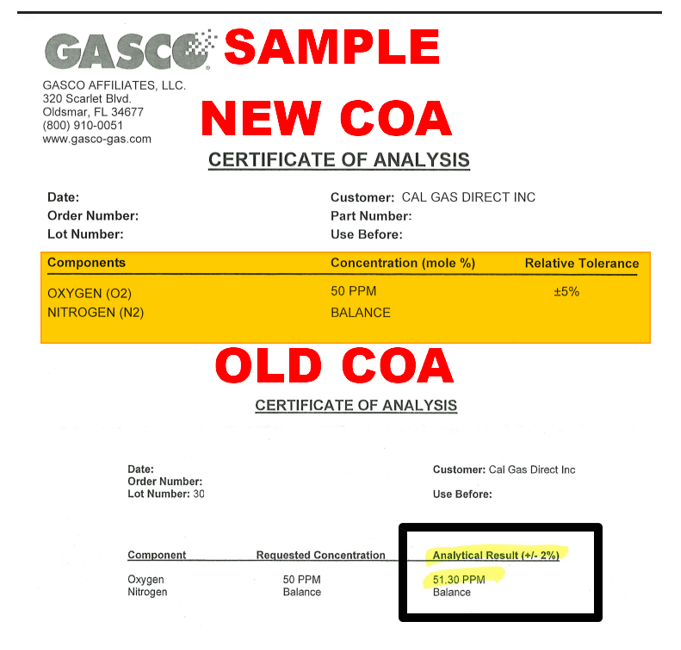
Certificates of Analysis [COA]
Where to find COA/SDS information for a Cylinder.
- Locate the code: Find the QR code printed directly on the main Calgaz cylinder label.
- Scan the code: Open your smartphone or tablet's camera app or any standard QR scanning tool and aim it at the code. No App needed.
- Access documents: The code will immediately redirect you to a digital portal to view or download the specific Certificate of Analysis (COA) and Safety Data Sheet (SDS) for that exact gas batch.
- No specialized apps, custom accounts, or login details are required to retrieve these files.
Understanding Relative Tolerance on Your Certificate of Analysis (CoA)
What is "Relative Tolerance"?
Historically, gas certificates listed two separate numbers: Blend Tolerance (the manufacturing window during cylinder filling) and Analytical Accuracy (the instrument precision during laboratory analysis).
To streamline certification and ensure tighter overall consistency, modern CoAs use a single Relative Tolerance. This specifies the maximum allowable variance between the target nominal concentration on the label and the actual contents inside the cylinder.
Tolerance Tiers & Example Calculations
Relative tolerance is calculated as a percentage of the ordered target concentration, not an absolute value:
| Concentration Range | Relative Tolerance | Example Ordered | Acceptable Range in Cylinder |
| < 5 ppm | -50% / +100% | 2 ppm | 1.0 ppm – 4.0 ppm |
| 5 – 20 ppm | ±10% | 10 ppm | 9.0 ppm – 11.0 ppm |
| 21 – 50 ppm | ±5% | 25 ppm | 23.75 ppm – 26.25 ppm |
| ≥ 51 ppm (and % Vol) | ±2% | 100 ppm | 98.0 ppm – 102.0 ppm |
How to Calculate Your Range:
-
Example (100 ppm CO / Balance N₂):
-
100 ppm x 0.02 = +/- 2 PPM
-
Guaranteed cylinder concentration: 98 ppm to 102 ppm
-
-
Example (2.5% Methane / Balance Air):
-
2.5% x 0.02 = +/-0.5%
-
Guaranteed cylinder concentration: 2.45% to 2.55%
-
Why Doesn't the CoA List a Separate "Actual / Tested Value"?
-
Certified to the Nominal Spec: Every batch undergoes the exact same rigorous analytical lab testing as always. Under the unified relative tolerance standard, the batch passes quality control only if the actual tested concentration falls inside the guaranteed relative window.
-
Repeatable Reordering: By certifying directly to the nominal concentration within a tight relative window, you ensure identical calibration baselines across repeat cylinder orders rather than dealing with batch-to-batch nominal drift.